
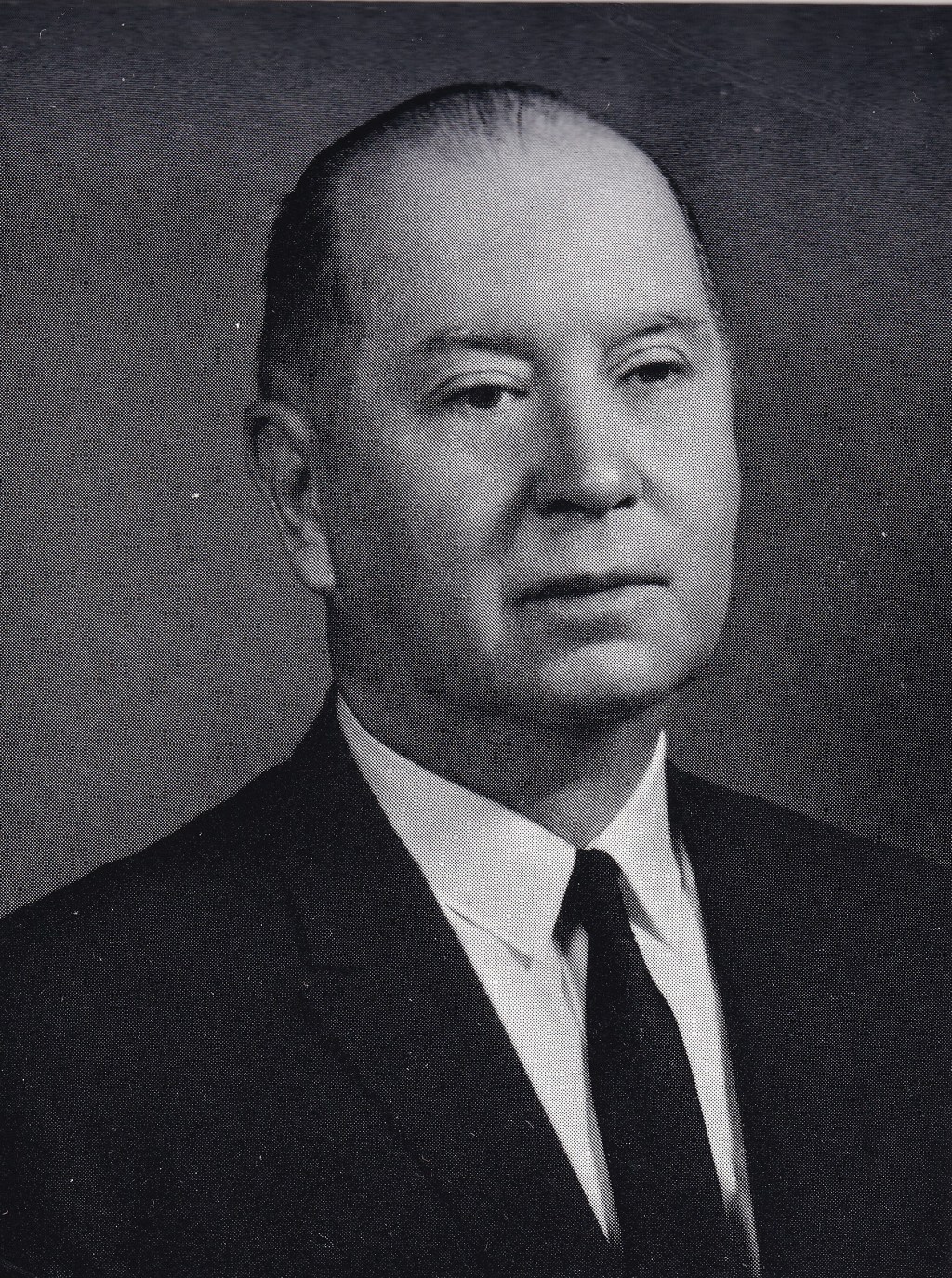
“Among Mr. Lawton’s most valued characteristics are his steadfast refusal to be discouraged, his persistence, his determination, his genuine appreciation of deep spiritual values, and his constant sense of humor which has served him and his colleagues well in tiding over many a discouraging situation.” – The Greenville News, May 28, 1939
Dr. Samuel Miller Lawton was a born-blind academic, preacher, and missionary to the blind who became one of the founders of North Greenville Junior College. His career was impressive by any standard, but the fact that he accomplished everything he did while blind makes his story even more remarkable. Dr. Lawton is believed to be the first born-blind person to earn a PhD in the United States and his work for the blind community in South Carolina still resonates to this day.
Samuel Miller Lawton was born on November 12, 1899, in Estil, South Carolina to parents Thomas Oregon Lawton, Jr. and Bessie Miller Lawton. T. Oregon Lawton was an alumnus of Furman University and Erskine who owned a farm when Sam was born. Bessie Miller Lawton, originally from Virginia, was a homemaker and the daughter of a physician. It is likely that Dr. Lawton was named after his maternal grandfather, Samuel Miller. Dr. Lawton was born with the genetic disease retinitis pigmentosa which causes blindness. While his younger sisters did not have retinitis pigmentosa, his younger brother, Thomas Maxwell “Max” Lawton was also born blind.
T. Oregon Lawton moved his family to the Pendleton Street area of Greenville, South Carolina in 1901 to manage the Alderman Lumber Company. By this time, it would have been clear that Sam was blind. The only school for the blind in South Carolina was in Spartanburg, so it is possible this was another reason for the family’s move. The Lawtons became members of Pendleton Street Baptist Church where they would remain throughout Sam’s childhood.
Mr. Lawton, along with his father, founded “The Oregon Lumber Company” in 1903 and the name eventually changed to “The Lawton Lumber Company”. Mr. Lawton served as the secretary and treasurer for the new company until 1910 when he joined the Southeastern Life Insurance Company as their Vice President and General Manager. Mr. Lawton would eventually become the president of the company and later founded two other insurance companies including Pioneer Life Insurance and Security Life and Trust Company. Max, the younger brother of Dr. Lawton, would follow in his father’s footsteps and have a long career in the insurance business. Max, despite his blindness, was a track athlete at Furman University. Throughout his life, he would attend speaking engagements with his guide dogs where he would give lectures and his dogs would do tricks.
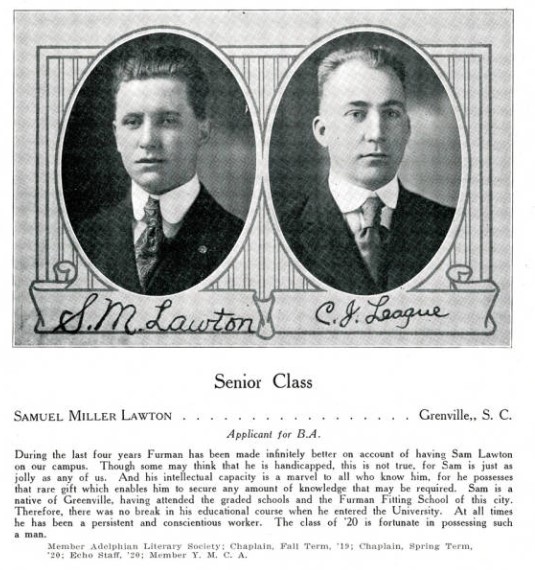
Education was important to the Lawton family. Sam attended regular schools until he was thirteen years old and attended Cedar Springs, the school for the blind, for one year. In 1914, T. Oregon Lawton fought for Cedar Springs to receive much needed state funds to complete a building project. Mr. Lawton wrote to the state senate, “If those who oppose the Cedar Springs dormitory appropriation had children there or had ever visited there, they would vote otherwise. To deny this appropriation is worse than criminal. No state institution needs attention like Cedar Springs.” The efforts of Mr. Lawton and others worked and the new building at Cedar Springs was completed in 1915. At Cedar Springs, Sam learned to use a typewriter, read Braille and New York Point, and started to play the violin. The Lawtons were a musical family and Sam frequently played violin and sang with his sisters in church and other events. Sam attended high school at the Furman Fitting School and then attended Furman University where he received his bachelor’s degree in 1920.
Sam Lawton moved to Kentucky after graduating from Furman to attend the Southern Baptist Theological Seminary to earn his Graduate of Theology (Th.G.) degree. It was during this time in Louisville that Sam met a Women’s Missionary Training Union student named Alice Stockton. The two fell in love and were married on April 24, 1924, after they had finished their degrees. That same year, the young couple relocated to North Carolina where they both taught at Mars Hill College.
Shortly after finishing their last semester teaching at Mars Hill, the Lawtons welcomed their first child into the world and named her Mary Elizabeth. The young family then moved to Nashville, TN while Sam completed his M.A. from George Peabody College for Teachers (now a part of Vanderbilt University). In 1927, the Lawtons moved to Arkansas where Sam was a professor of education in the extension department of the Arkansas State Teacher College and Alice taught in the public schools. While in Arkansas, the couple’s son was born, and they named him Francis “Frank” Lawton. Frank Lawton became a pilot in the Air Force before joining the ministry. He wrote several books and served in churches for more than 25 years in various roles such as music minister, pastor, and educational director. He later managed a Lifeway Bookstore for 16 years and started his own company, Lawton Robes.
In 1929, the Lawtons moved back to Greenville County, South Carolina, to take teaching positions in the history and Christian Education departments of a small school named North Greenville Baptist Academy where Sam’s father, T. Oregon Lawton was a long-time trustee.. The family only stayed in South Carolina for one school year before moving to Nashville, Tennessee where they both entered graduate school at Peabody College. Sam worked on his PhD residency requirements while Alice obtained a Master of Arts degree.
After Sam’s residency requirements were finished and Alice had completed her degree, the couple returned to South Carolina and spent a year in Beaufort while Sam worked on his dissertation research. In the fall of 1933, Dr. Donnan, the principal of North Greenville Baptist Academy, offered room and board to the Lawton family in exchange for Sam completing a special project for the school. The special project was to create a survey of junior colleges to examine the advisability of North Greenville becoming a junior college. Over the next few months, Sam and Alice studied junior colleges in South Carolina, North Carolina, and Georgia. They traveled across all three states to visit campuses, meet with junior college presidents, and gather information. In the end, the Lawtons discovered that the faculty of North Greenville Baptist Academy was more qualified to teach college than many of the faculty members at those junior colleges.
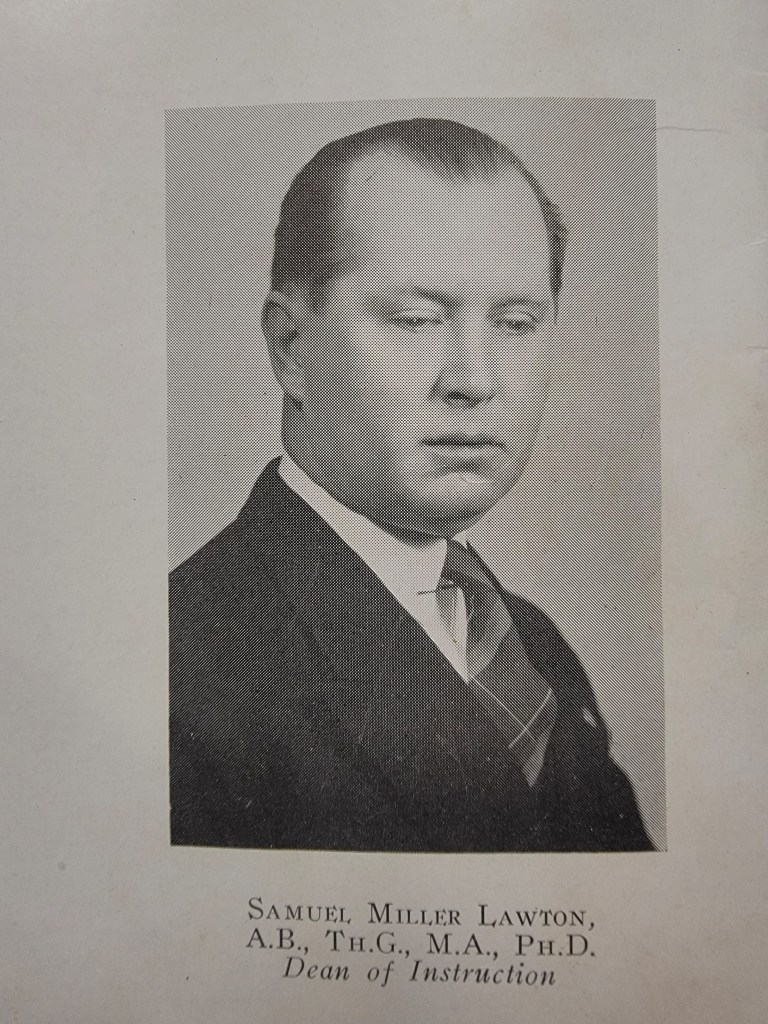
When his fifty-page report was complete, Sam presented it to Dr. Donnan and the trustees. The meeting was held in the prayer room of the old men’s dormitory, Taylor Hall. The trustees unanimously voted to start the first year of junior college work at North Greenville. Sam’s vision was for the new college to be named “Aurora College” because it was the northernmost school in South Carolina and shined the light of Christian education across the area, but the name change never occurred. Sam Lawton was elected as the Dean of Instruction, making him the first academic dean of North Greenville Junior College. At the time, only one other blind person was serving as an academic dean of a college.
Once the trustees approved North Greenville to become a junior college, the next phase of work began. For the junior college to be successful, they needed the support of senior colleges in the area. Once again, the Lawtons took to the road to gather support for North Greenville. The Lawtons and Dr. Donnan, the school’s first president, convinced Coker College, Wofford College, and Furman University to accept North Greenville Junior College graduates. The president of Furman University was hesitant at first and offered to let North Greenville Junior College graduates into Furman if they could pass an examination on the subjects where they had earned credit at North Greenville. Dr. Lawton told the Furman president that his suggestion was unacceptable because it reflected badly on the North Greenville faculty. He pointed out that many of the first and second year classes at Furman were taught by seniors who had not yet graduated while all of the faculty at North Greenville held master’s degrees. The president of Furman was finally convinced, and North Greenville graduates were accepted without testing.
The next challenge was to get the South Carolina Department of Education to recognize North Greenville as a college. Together, the Lawtons made their case to the superintendent in Columbia. He was so impressed by their arguments that he gave them a recognition letter to take back to North Greenville and agreed to be the commencement speaker at the first graduation of North Greenville Junior College in 1936.
1936 was a special year for Sam. Not only did he witness the first class graduate from the junior college he co-founded, but he was also ordained as a minister. The service took place June 17, 1936, at Pendleton Street Baptist Church. Rev. Lawton received a Bible from Lewie H. Miller, Sr. (father of the creator of the Miller Bible Museum at North Greenville), and the ordination prayer was offered by Dr. Donnan.
Throughout this time, Sam was working on his dissertation to complete his PhD. His research focused on the religious practices of the Gullah people in South Carolina, so he frequently spent summers in the low country in addition to the year he had spent living in Beaufort. In all, he attended over 250 religious services and conducted interviews with the Gullah people. Sam believed that his blindness was an asset during his research because he felt accepting assistance from the sympathetic Gullah people with moving about in their churches put them more at ease with him. Early on in his research, he was able to create a pocket recording device to capture the services so that he would not be a disturbance. Dr. Lawton graduated with his PhD. from Peabody College on June 2, 1939. Research was done at the time to determine if Dr. Lawton was the first born-blind person to earn a PhD in the United States. While not certain, it was concluded that Dr. Lawton was likely the first. The other known blind PhD holders at the time were not born blind.
During their time at North Greenville, Sam served as the pastor of both the North Greenville Baptist Church, which would later be named Tigerville Baptist Church, and Tyger Baptist Church. During his time as pastor of North Greenville Baptist Church, the congregation grew from 50 members to 100 members. In 1941, Sam resigned from North Greenville Baptist Church to devote more time to his roles at North Greenville Junior College and Tyger Baptist Church. A year later, the Lawtons resigned from North Greenville Junior College and relocated to Spartanburg where Dr. Lawton was serving as pastor of Cedar Springs Baptist Church in addition to his pastorate at Tyger Baptist Church. Dr. Lawton also took a position as chaplain and religion professor at Cedar Springs Institute in Spartanburg, the school for the blind that he had attended when he was thirteen. In honor of the Lawtons, the “Sam and Alice Lawton Award” was created and presented each year to the married students who contributed the most to the life of North Greenville.
Despite the move, Dr. Lawton continued to serve at Tyger Baptist Church and led the congregation through WWII as twenty-six members served overseas. By the grace of God, all twenty-six Tyger Baptist Church servicemen returned home from the war. Dr. Lawton resigned as their pastor in 1946 after over ten years of leadership. Years later, at a dedication service for a historical marker at the church, Mrs. Lawton recalled this story from their time at Tyger:
“One Sunday morning, a heavy wind and rainstorm came up while we were in the church. The tower creaked and rocked. Once in a while the bell clapper would sound against the thick walls of the big bell telling us that the winds were strong and powerful. My husband was trying to continue his well-prepared sermon. Suddenly, as the sounds were louder and the entire building shook, he said, “Do you think we should go to a place of greater safety? The storm is heavy.” Mrs. Heath, a dear Christian soul of many years, who had made a big effort to come that day and who was sitting on the front seat so she could hear better, spoke in clear, confident tones, “No. We are safe here. You go right on preaching, Dr. Lawton. The Lord is taking care of us.” He obeyed. The storm ceased. We all felt and knew that God was there with his wonderous work and his power to save, to give comfort and refreshment to the soul.”
The University of South Carolina approached Dr. Lawton in 1950 and asked him to begin teaching religious extension courses in the upstate. He agreed, and the first classes were held in Greer and Spartanburg. Eventually, psychology and other classes were also offered, and the locations varied throughout the upstate. Dr. Lawton also continued to serve as director of religious education and chaplain of Cedar Springs and was active in the work of the Spartan Baptist Association where he held roles such as Superintendent of Sunday Schools, President, and moderator.
“In the company of the admirable ones who came into our world bereft of the gift of sight, there is no more heroic one than Dr. Sam M. Lawton of South Carolina.” – Chester E. Swor in “Neither Down Nor Out”
Dr. Lawton had a passion for helping others in the blind community and began to organize monthly religious gatherings for the blind in Spartanburg County in 1944. He named his group “The Aurora Club” and their purpose was to promote the social, spiritual, and economic welfare of the blind. Through the work of Dr. Lawton and others, the Aurora Club spread throughout the state and the Aurora Club of South Carolina became the state affiliate of the National Federation of the Blind in 1956. South Carolina, by the 1960s, was in the top ten states with the largest number of new blind cases but was limited in the resources offered. Dr. Lawton believed that the blind needed their own commission and that a division of the state welfare department was insufficient. His desire was for the blind to be able to support themselves and not just rely on welfare because he knew they were able to accomplish anything. He felt that the welfare department was not doing enough to aid in that goal. In a 1965 speech to the joint SC House-Senate hearing on the Commission for the Blind bill, Dr. Lawton stated, “There is nothing well nor fair about the Welfare Department.”
The work of Dr. Lawton and others paid off in 1966 when the state legislature approved the creation of the South Carolina Commission for the Blind (SSCB) to oversee the services for the blind in South Carolina. Dr. Lawton was selected by the governor to serve on the first commission and was soon elected as its first chairman. The SSCB began running as a separate agency from the State Department of Public Welfare the next year. In addition to his work with the blind in South Carolina, Dr. Lawton was also active with the National Church Conference of the Blind and frequently spoke at their annual meetings.
Dr. Lawton loved to travel and did so throughout his life. As a college student, he toured Biblical lands and frequently spoke to churches about his time there. His daughter, Mary Elizabeth, was a doctor who married another doctor and the two were Southern Baptist missionaries in Nigeria. Dr. Lawton and Alice often visited their daughter during the summers and also traveled to Europe. The couple also had a summer home at Ridgecrest, North Carolina where they would stay when they were not overseas traveling.
Dr. Lawton would once again serve at North Greenville Junior College in 1968 when he was selected as a trustee of the school. His term was cut short in 1971 when Dr. Lawton unexpectedly passed away from a heart attack at his Ridgecrest home just before his 72nd birthday. He is buried at Ridgecrest Memorial Park in North Carolina with his wife and other Lawton family missionaries. Dr. Lawton’s tombstone is marked “Missionary to the blind” and includes the Proverbs 3:6 verse, “In all thy ways, acknowledge Him, and He will direct thy paths.”
In his honor, the men’s dorm at North Greenville was named “Lawton Hall” the year after his death. Lawton Hall was torn down nearly a decade later, but Dr. Lawton’s legacy at North Greenville will always remain. Dr. Gene Fant, the president of North Greenville University, recently named the provost’s office in honor of Dr. Lawton.
At the time of his death, Dr. Lawton had a weekly radio show on WSPA where he gave a Sunday School lesson. WSPA released the following statement about Dr. Lawton’s life:
“South Carolina has lost a fine citizen. The blind people of South Carolina have lost a great friend. Dr. Sam Lawton has been called by the One he served so well these 71 years. Dr. Sam Lawton has been known by radio listeners over the past quarter of a century. Most recently he was heard each Sunday morning with the International Sunday School lesson on WSPA Radio. Dr. Sam was a remarkable man, his handicap, blindness, did not deter his zest for living, nor his work for the Lord. He treated his handicap as though it did not exist. Dr. Sam turned on the light in a darkened studio to see by. He used his braille watch to keep time on the exacting requirements of a radio show and most times he did it better than those who could actually see. His accomplishments had been noted on more than one occasion. ‘Man of the Year’ awards came his way from the Spartanburg Sertoma Club and the Regional District of Sertoma International and the South Carolina Association of the Blind bestowed upon him the ‘Man of the Year for Outstanding Service to the Blind.’ A Baptist missionary to the blind, a former University of South Carolina Professor, Chairman of the South Carolina Blind Commission, and Chaplain of the State School for the Deaf and Blind here in Spartanburg for 30 years, were just a few of the tasks he performed. Dr. Sam Lawton will be missed most by those closest to him, but his passing will leave a void for both the sightless and those who can see. He gave of his time freely and without reservation to those who needed his services. He was living proof that no man has a handicap which he can’t overcome. For Dr. Sam Lawton for 71 years was sightless and yet he saw more than those of us who are blessed with two eyes will ever see. Dr. Sam Lawton, friend, teacher, preacher, humanitarian, has left his world of darkness only to gain eternal light in another world.”
 From These Roots
Leave a comment