
“I thank God that I was one of your pupils in those needy days before I became a Christian.”– J. Dean Crain in a 1943 letter to O.J. Peterson
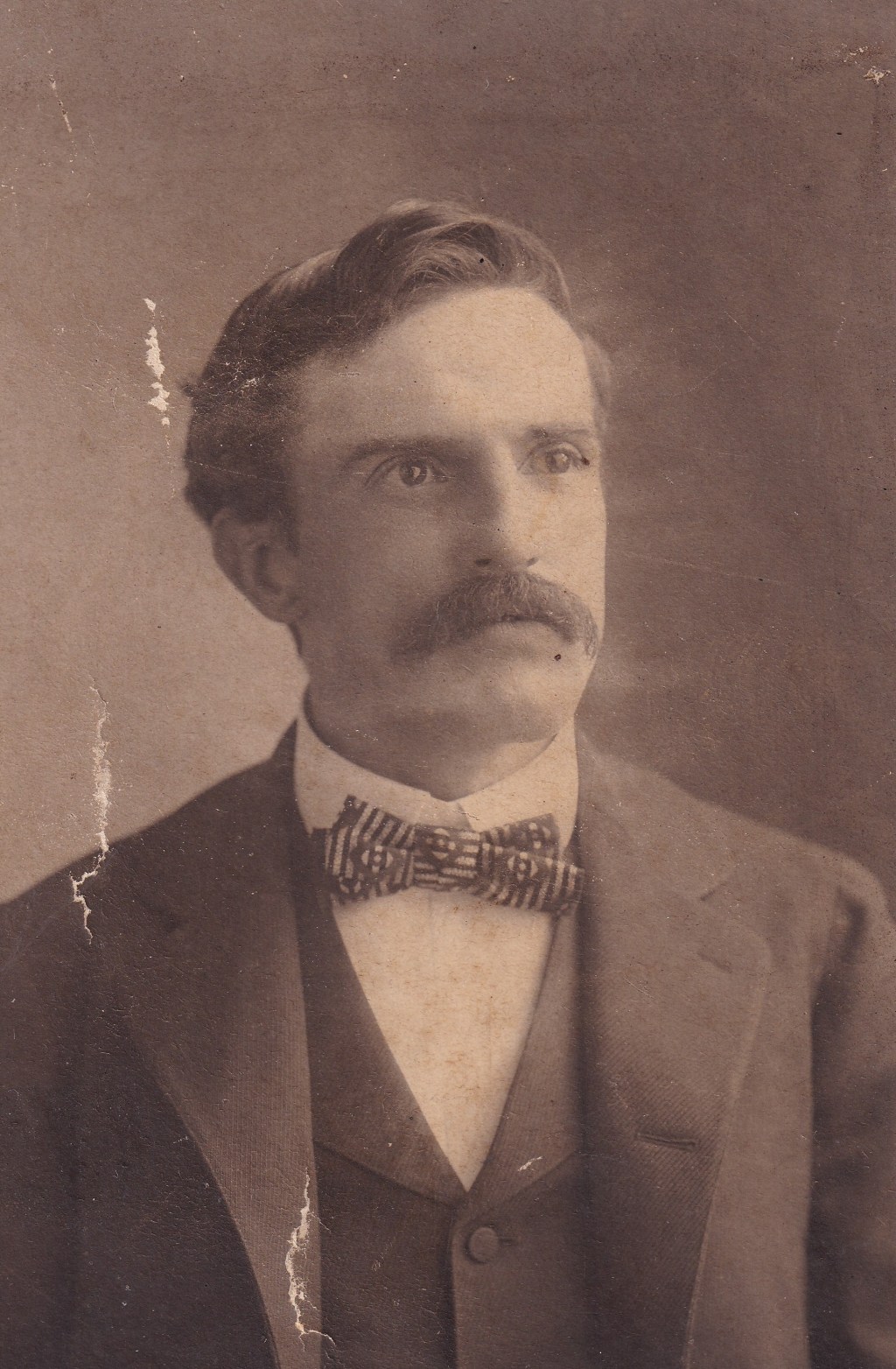
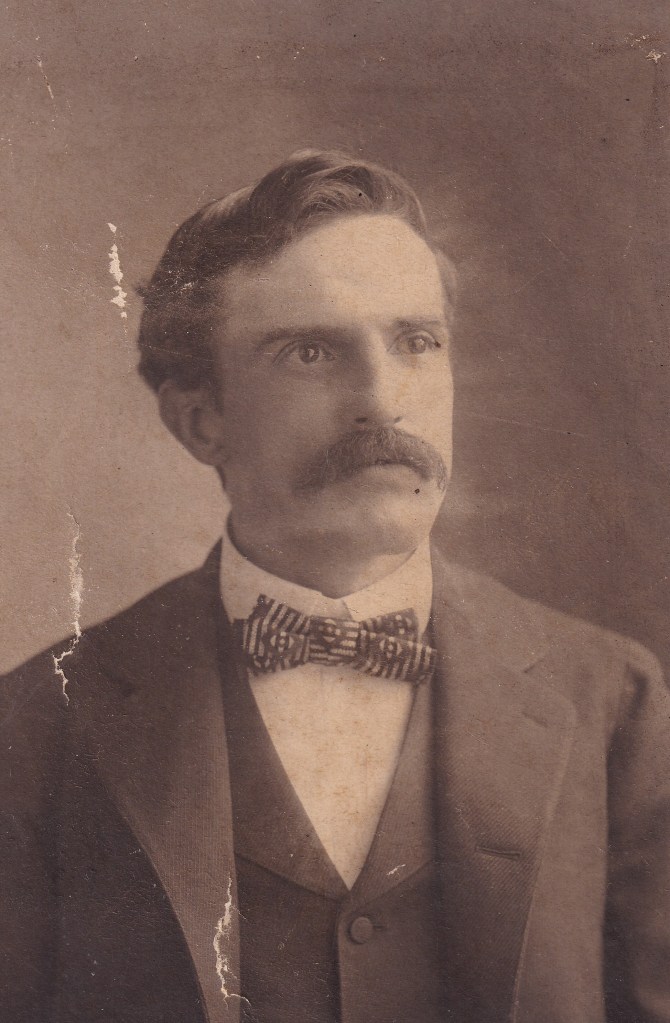
Oscar James Peterson, Sr. was born December 19, 1869, in Sampson County, North Carolina, to parents Robert Peterson and Rebecca Herring Peterson. The Petersons were farmers, and O.J. was the second youngest out of about nine kids. However, O.J. decided to pursue an education rather than farming, and he graduated from Wake Forest College in 1892. That same year, he became principal of Burgaw High School in North Carolina. In 1894, O.J. took a position as principal of Clyde High School in Haywood County, North Carolina, but only stayed for a year before becoming Enfield Collegiate Institute in Halifax County, NC.
O.J. married a woman named Martha Isabella “Mattie Bell” Williams on January 15, 1895. A year later, in 1896, they had their first daughter, Nellie, who weighed in at 12lbs. Surprisingly, after that first large birth in the days before epidurals, the couple would go on to have four other children together, including Lucile, Oscar Jr., Elsie, and Gladys.
In 1896, the Petersons relocated to Wilkes County, NC, when O.J. accepted the position as principal of Ronda Academy after their principal passed away. He finished out the school year at Ronda before accepting a position at Pinnacle Academy. It was around this same time that O.J. Peterson was ordained as a Baptist minister.
In 1898, he became the third principal of North Greenville High School. When he arrived on campus, the outlook was not good. According to a newspaper article at the time, North Greenville was having a hard time attracting students outside of Tigerville because other communities in the area felt that the school should have been built in their location. Enrollment was dwindling, and North Greenville was not expected to last much longer. During his first session at North Greenville, he only had 22 students. However, he used that as an opportunity to do his best work. He also recognized the need for the school to advertise. So, that is just what he did. Peterson traveled around the area speaking at as many churches as he could about the importance of North Greenville and the good work the school was doing.
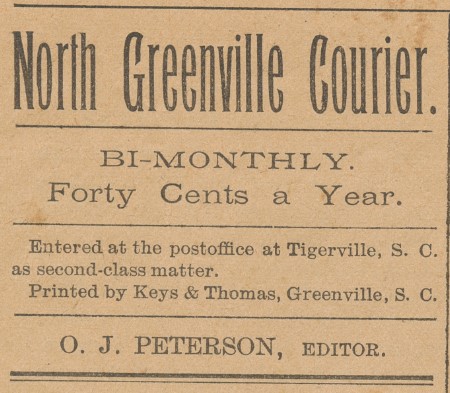
In addition to his travels to local churches, he attended the 1898 North Greenville Baptist Association meeting and proposed two resolutions. The first was that the association minutes should include an advertisement for the high school. The second was that the association should have a newspaper. This newspaper was named “The North Greenville Courier”. The majority of the paper included stories from “The Baptist Courier”, but the last page was dedicated to local news. He knew the importance of advertising to increase the number of students at North Greenville and he believed a newspaper would be a cost-efficient way to do so.
Peterson’s attention to his 22 students, traveling around to local churches, and his focus on advertising worked. By his second year at the school, enrollment surged to 68 students. He published the first school catalog in 1901, organized the A.C.H. literary society on campus, formed a military department at the school, and was known to be a brilliant man and an incredible teacher. In addition to his duties at North Greenville, Mr. Peterson also preached occasionally and was instrumental in the North Greenville Baptist Association forming one of the first (if not the first) summer Bible Schools in the state.
Peterson left North Greenville in 1901 to take a principal position at the Robeson Institute in Lumberton, North Carolina. According to one of his former Wake Forest professors, “Strong inducements were offered to keep him in South Carolina, but tar-heel spirit and opportunities for usefulness in a progressive public spirited community overcame them all and brought him back to the section of his birth.” However, his work at North Greenville left the school in a much better position in both finances and name recognition. David Ballenger said of Peterson, “He took hold of it [North Greenville High School] at a time when it was almost dead and was rapidly on the decline, and has restored it to life again. He has elevated it to a plane beyond what it has ever been before.”
While serving as the principal of the Robeson Institute, Peterson also edited a local paper named “The Lumberton Argus”. After a year as principal, he resigned from the position to dedicate more of his time to his editorial and ministerial work. Peterson worked to make “The Lumberton Argus” a success and remained as the editor and manager of the paper until it was sold in 1906 to the other newspaper in town. Later that year, he returned to education when he took a position as principal of the Tupelo Institute in Carnesville, Georgia.
In 1909, Peterson took the leap from high schools and academies to higher education when he took the position of president of the Louisiana Female College at Keachie. He remained in this role until shortly before the school closed and was succeeded by Louisiana Christian University. The Peterson family stayed in Louisiana for a few more years while O.J. taught Latin at Louisiana Christian University and served as principal of Bernice School.
Peterson’s love of newspapers never left him, and in 1917, he purchased “The Sampson Democrat” and returned to his hometown in North Carolina. He did not leave the field of education long, though, because in 1918 he accepted a position as principal of Salemburg High School while remaining the editor of “The Sampson Democrat”. Peterson wrote in a news article at the time that the second job was partially to ease the financial strain of a long move and purchasing a newspaper, but also because the former principal of the school had been drafted into WWI, and he felt that in times of war, everyone should be doing more work.
O.J. Peterson often used his newspaper to wage war against things he felt were immoral, such as moonshining and improper dancing. “The News and Observer” wrote about Peterson in a 1919 edition of their paper. The article stated, “One of the boldest and most useful editors in North Carolina is O.J. Peterson of the Sampson Democrat. Some men run newspapers as they would a peanut stand with nothing else in view than to make money… Peterson is not of this class. He makes his paper a power for law enforcement. Eternally, he wages war on the blockaders of Sampson County and the lawlessness of all sorts. Injustice and public unfairness of any sort find him unfailingly on guard in behalf of what is fair and right. Always he holds aloft the banner of purity and clean living. That which comes from the heart, that which is beautiful and tender in human relationships are held up to admiration in his paper. The result is that every issue of the Democrat is a force for human betterment.”
Peterson owned and edited “The Sampson Democrat” until 1924. He had always had his newspaper printed by contract with a local printer, but that agreement had ended. He was faced with the difficult decision to sell his newspaper or open up his own print shop. He decided that opening a print shop when there was already one in town would be financially irresponsible, so he sold his paper to a man named W.W. Casteel. Soon after that sale, Casteel also purchased the town’s republican newspaper and combined it to create a politically independent paper.
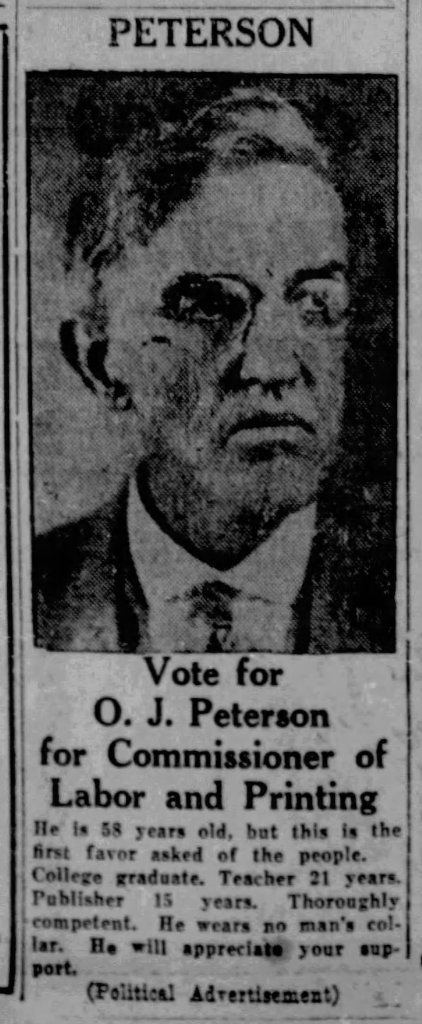
A few months after selling his paper, Peterson announced that he was running as a candidate for the North Carolina Commissioner of Labor and Printing. He was a long-shot candidate, but got further than most people thought he would. However, he lost to another primary candidate. One of his friends at the time told a reporter that he did not think Peterson ran to win the election, but wanted to simply shake things up a bit. In 1928, Peterson ran a second time in the primary for NC Commissioner of Labor and Printing. He lost the race for a second time and never pursued it again.
Soon after losing his first primary election attempt, Peterson made the decision to return to editorial work, and he purchased “The Chatham Recorder” in Pittsboro, North Carolina. His work at “The Chatham Recorder” was praised by other journalists, and an article in “The Raleigh Times” stated, “O.J. Peterson is so honest that sometimes we feel inclined to bleed for him. But he carries on with the spirit of a man getting a great kick out of a hard but well loved job.”
Disaster struck Peterson’s newspaper business in 1927 when a fire destroyed the newspaper’s building and all of its equipment. Unfortunately, Peterson did not have insurance, and the damages totaled an estimated $3,800. Despite the setback, “The Chatham Recorder” was back to publishing by the very next week. That would not be the last fire at the newspaper’s headquarters, though, and another fire would later destroy the building a second time.
Peterson owned and edited “The Chatham Recorder” until 1933, when he sold it to start a new, state-wide paper named “The State’s Voice”. “The State’s Voice” was a semi-monthly paper based out of Dunn, North Carolina, and offered articles on both political and theological topics. Peterson said that his new paper was not a newspaper in the traditional sense. He expected his readers to have already read the news before they looked at his paper. Peterson warned his potential readers that he expected them to think. In addition to editing “The State’s Voice”, Peterson also wrote articles for the local paper, “The Dunn Dispatch.”
Despite the excitement of starting a new paper that year, 1933 was one of the most difficult years for the Peterson family. Their daughter, Gladys, was only 23 when she died of spinal meningitis. On top of losing their daughter, the Petersons’ house burned down just a few months later. Thankfully, no one was injured, and most of their possessions were saved.
By 1935, after 33 months, Peterson was tired of trying to make “The State’s Voice” a statewide newspaper and ended the paper. His health was on a decline, and he thought that running a smaller paper again would help. That same year, he purchased “The Red Springs Citizen” newspaper and changed the name to “The Robeson Voice”. However, after another fire destroyed his office building and winter weather made working difficult, Peterson decided to retire from the newspaper business. He wrote in a 1936 article, “I turned ‘The Robeson Voice’ over to that good newspaper man J.P. Wiggins and sat quietly in my domicile during the bitterly cold weeks, taking it easy. The reaction, after many years of incessant work, so so great that it has been difficult to force myself to write at all. If it had been April instead of January, I probably should have held on to ‘The Voice’. Yet, if God wished me to abide in Robeson, the manifestation of His will was past my interpretation.”
The Petersons returned to Sampson County in 1936. Peterson wrote at the time, “I have ‘looked homeward’ and am Home, and no echo of ‘l-o-s-t’ resounds in my ears.” As his health allowed, Peterson continued to write columns for local newspapers. He also pushed for Latin to be taught in high schools and even wrote his own Latin textbook, but the idea was not adopted by the local education department.
O.J. Peterson passed away on December 22, 1945. He is buried in Springvale Cemetery in Clinton, North Carolina. In 1963, a wing of the former men’s dorm, Lawton Hall, was named in honor of O.J. Peterson. Lawton Hall was torn down around 1981.
 From These Roots
Leave a comment