

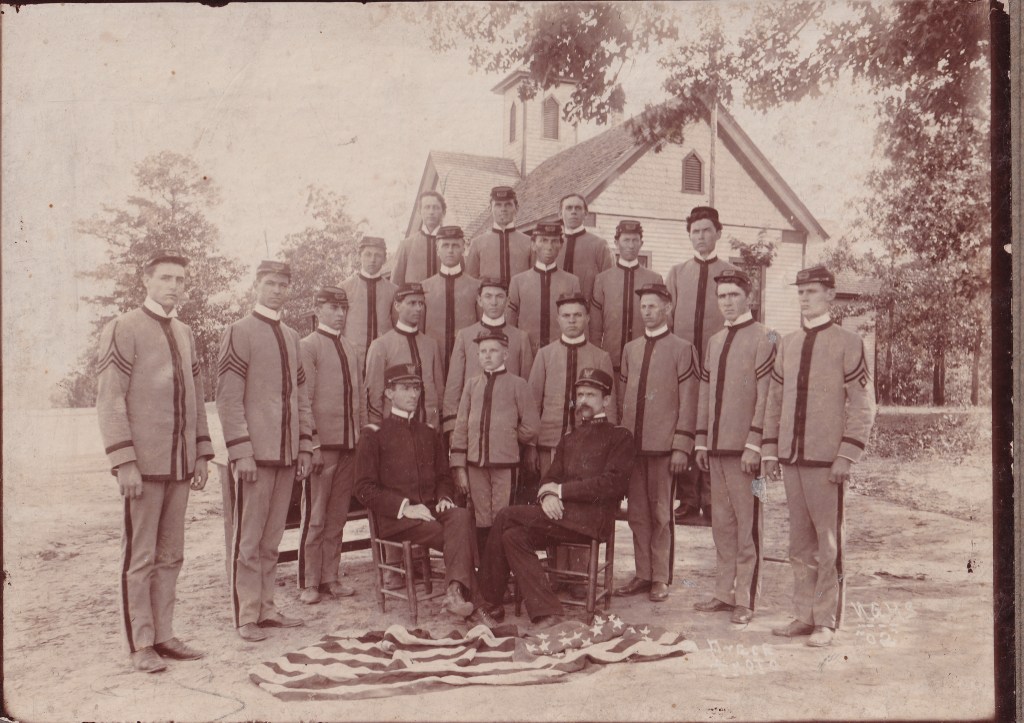
Edmund Bellinger Jackson was born on June 29, 1879, to parents Wiley Quitman Jackson and Laura Ann Jeffcoat Jackson in Aiken County, South Carolina. The Jacksons were poor farmers, but Edmund Jackson made his education a priority when he was not plowing fields. Through his hard work, he earned a scholarship to attend The Citadel where he graduated in 1901 and gave the salutatory address.
Mr. Jackson’s first job after college was at North Greenville High School in Tigerville, South Carolina. He was in charge of the school’s new military department and he took on the title “Captain Jackson”. The program was modeled after The Citadel and Captain Jackson set out to give discipline to the wild young men put in his charge. According to Principal O.J. Peterson, Captain Jackson was “a man of extraordinary energy and enthusiasm.” He quickly gained the respect of the boys on campus and taught them manners like how to enter a room, how to stand, and how to tip their hates. He was also the first man to ever tell them that it was not polite to spit on the floor in church.
Mr. Jackson abhorred liquor, but he loved to dance. North Greenville students were not allowed to speak to the opposite gender at the time, but they would sometimes gather off campus at local homes. Captain Jackson frequently attended these dances with his students. At one such dance, Captain Jackson, J. Dean Crain (who later became a principal of North Greenville), and the other North Greenville boys showed up a little late in their military uniforms. When the local girls saw them, they rejected many of the local boys to dance with the uniformed boys. The local boys had been drinking a bit too much and decided to challenge the North Greenville group to a fight. The middle of the dance floor quickly cleared and, according to witnesses, what followed was “one glorious knock-down, drag-out, free-for-all fracas. Although outnumbered, the North Greenville students held out bravely until one of the attackers seized a fiddle from the protesting musician’s hands and smashed it to bits over Dean Crain’s shoulders. He edged over to Mr. Jackson and said, ‘Cap’n, it’s time we were going home.’ Forming a wedge, the North Greenville boys battled their way out, and having gained the comparative security of the night, walked back across the hill to their lodgings.” (Story from Jean Martin Flynn’s A History of North Greenville Junior College)
Mr. Jackson only stayed at North Greenville for one year before moving back to his hometown of Wagener, South Carolina in 1903. That same year he married his first wife, Fannie Lybrand who he would go on to have two children with named Edmund Lybrand Jackson and Hazel R. Jackson. In Wagener, he took a position as the assistant principal of Wagener High School. After a year as assistant principal, he was promoted to principal and served one year in that role. After three years in education, Mr. Jackson made a career move into banking. In addition to being a farmer, he took a position as the cashier of the Bank of Wagener.
Mr. Jackson remained in his position as cashier until 1912 when Pickens Gunter, the President of the Bank of Wagener, was murdered by the mayor of Wagener, Hugh Long. According to witness accounts, Mr. Long had given Mr. Gunter a nasty look while walking down the street. Mr. Gunter started a fight with Mr. Long and Mr. Long drew a gun to defend himself. Mr. Long’s first shot missed and a cousin of Mr. Gunter pulled him off of Mr. Long. While Mr. Gunter was being held by his cousin, Mr. Long took another shot and mortally wounded Mr. Gunter. When Mr. Jackson heard what had happened to his boss, he rushed to the man’s home to prepare his will. Mr. Gunter recounted his side of the story to Mr. Jackson just before he succumbed to his wound and passed. Because of this, Mr. Jackson served as a witness in the murder trial. After the death of Mr. Gunter, Mr. Jackson was promoted to the President of the Bank of Wagener.
As a farmer and bank president, Mr. Jackson wanted to use his position to help other farmers. Farmers had a hard time getting loans with good interest rates and Mr. Jackson decided to change that policy. He so frequently gave loans to local farmers at 6% interest that the bank’s success became tied to agricultural success. In 1915, he led his bank to become a member of the Richmond Federal Reserve Bank and the bank’s name changed to The First National Bank of Wagener.
Mr. Jackson became involved with local politics soon after moving back to Wagener. In 1913, he represented Aiken County on a committee to discuss the formation of a new county named Edisto County that would include parts of Aiken County and Lexington County. The voters decided in 1914 not to form a new county, but Mr. Jackson stayed active in political affairs with work on the county council and a term as mayor of Wagener.
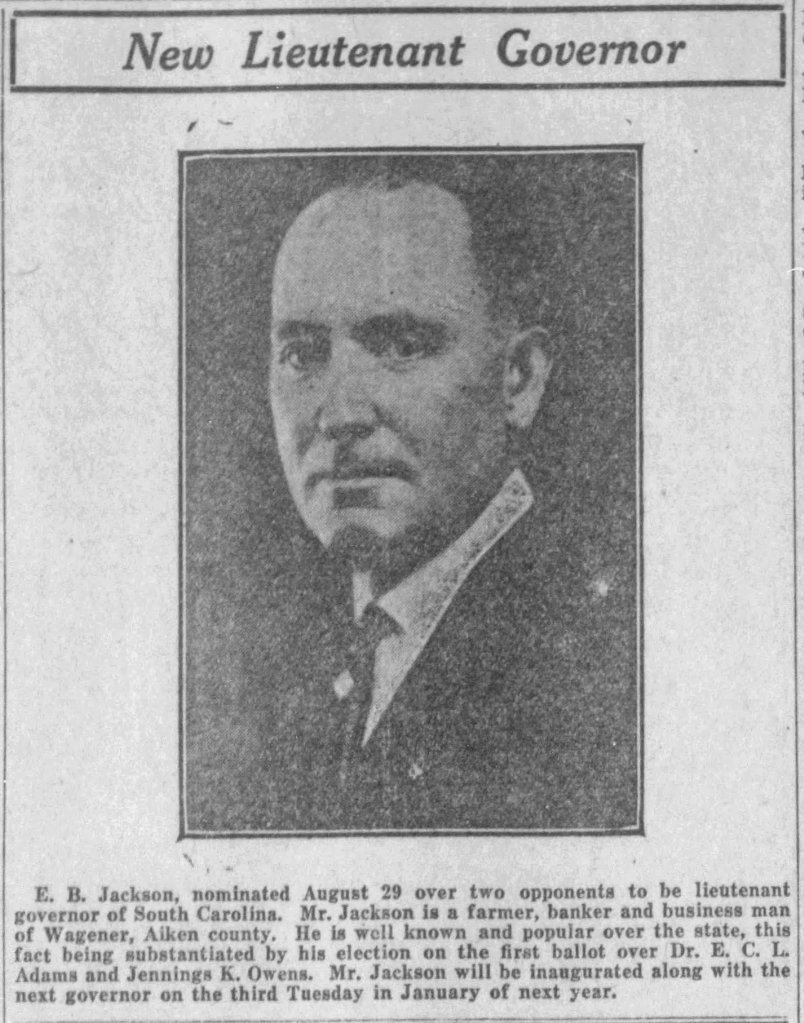
Mr. Jackson was approached by friends and acquaintances to run for Lieutenant Governor of South Carolina in 1922. He decided to run on a policy of helping farmers and increasing education. He was an ardent supporter of education and believed that a better educational system would decrease crime. In one speech he stated that he would “today be plowing an ox on a rented farm if it had not been for education.” He also had the position that taxes should be increased on luxury goods like Coca-Cola in order to keep taxes lower for farmers and other landowners.
He was a talented public speaker and this served him well on the campaign trail. When he spoke at events with the other candidates for Lieutenant Governor, he was frequently labeled as the one with the best reception from the crowd. When his allotted time ended at an August political event, one of the spectators yelled out, “Let him go on!” He also appealed to women because he said he was glad they had the vote and would bring more civility and morals into politics.
Towards the end of the campaign, a member of the Ku Klux Klan wrote a letter to the newspapers where he accused Mr. Jackson of “loving Catholics and other enemies” and having a bad moral character. He appealed to other KKK members to vote against Jackson in the election. In response, local pastors and citizens who knew Jackson well wrote letters supporting his candidacy and accusing the letter writer of trying to seek revenge on Mr. Jackson for not helping him avoid the draft during World War 1. Jackson became so popular that when the election results came in that November, he won by a majority landslide against the two other candidates negating the need for a run-off.
Edmund Jackson was sworn in as the South Carolina Lieutenant Governor on January 16, 1923. During his first term, one of the tie-breaking votes he had to cast was in regard to a soda tax. His vote extended the soda tax in the state because he believed that keeping taxes higher on non-essential goods would keep the taxes lower on essential items. When he ran for re-election in 1924, he did so unopposed and was elected for a second term.
Mr. Jackson announced in 1926 that he would be running for Governor of South Carolina. Five other candidates also entered the race and the main topic quickly turned to the “soft drink issue.” The candidates were split on the soft drink tax. Jackson and others wanted to retain the “Coca-Cola tax” while others wanted it abolished. Supporters of the “Coca-Cola tax” like Mr. Jackson accused the other side of being in the pocket of Atlanta businessmen who were only looking out for their own interests in the Coca-Cola business. One editorial at the time asked voters who they believed should lead their state- Atlanta or Carolinians? Jackson stated in one debate, “I will vote against any bill that takes the tax off Coca-Cola and puts it on the farms and small homeowners.” Opponents of the “Coca-Cola tax” rejected this claim and denied being paid off by Coca-Cola. Although some candidates tried to steer the debate away from soda, it remained one of the major issues throughout the entire election season.
Mr. Jackson finished in a close third in the primary election for Governor and declared that he would be back to run again in 1930. In addition to his work as Lieutenant Governor, during this time Mr. Jackson remained the president of the First National Bank of Wagener, served as the chair of the board of trustees for Greenville Women’s College (later combined with Furman University), and was elected the First Vice President of the South Carolina Baptist Convention in 1927.
After losing the election, Jackson returned to full-time banking and farming in Wagener. However, in early 1929, after a failed attempt to merge with the Bank of Western North Carolina, the First National Bank of Wagener permanently closed its doors. He spent the next few years in county council work and was elected to The Citadel Board of Visitors in 1932.
1933 was an emotionally mixed year for Mr. Jackson. That summer, his son, Lieutenant Lybrand Jackson, was killed in an airplane crash at Langley Field during gunnery practice. A couple of months later, Jackson moved to Washington D.C. to take a position as a Regional Consultant to the Agricultural Adjustment Administration. His role was as a cotton expert and his committee was to advise the administration on offers received by producers.
Mr. Jackson took another hard hit in 1934 when his wife of 31 years, Fannie, passed away from illness. Shortly after her death, Jackson took a new position with the Agricultural Adjustment Administration and was sent to Puerto Rico to assist with rehabilitating agricultural conditions on the island. After about a year in Puerto Rico, Jackson returned to the States and continued work with the Agricultural Adjustment Administration (AAA).
In 1938, Mr. Jackson married his second wife, Mary Inez Toler. Mary was a younger woman and the couple had one son together named Edmund Bellinger Jackson, Jr. He continued to work for the AAA as a claims adjuster until he died in 1947. His funeral was held at his home church, First Baptist Church Wagener and his service was led by his former student J. Dean Crain.
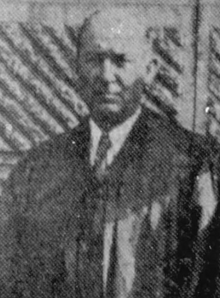



 From These Roots
Leave a reply to English Burlos Cancel reply